
The New Defense Primes: How the Next Generation of Tech Will Scale
By Renny McPherson
August 14, 2026
Thank you to First In principal Jessica Nelson for research support.
With tens of billions of dollars flowing into defense technology in the first several months of 2026 alone, it is worth pausing to consider the future of the sector and how today’s high-potential defense tech leaders might evolve over the next decade. Today’s early winners will have the option to go public before the end of the decade. By 2030–2035, as several of these companies mature, a new, more scalable era of defense tech will emerge. We expect the winners to evolve into massive platforms; simultaneously, we anticipate high-profile failures among companies that raised too much capital without a clear vision or the ability to execute relentlessly.
At First In, we see a strong parallel between the defense tech companies founded between 2022 and 2027 and the cybersecurity boom of 2005–2011. While the historical specifics of the cyber boom may be fading from memory, the structural lesson remains: legacy architectures cannot handle modern threats. Just as a cohort of visionary, execution-focused founders recognized that legacy security could not handle cloud-native network threats, today’s defense founders are identifying the limitations of outdated systems. That earlier cycle gave us foundational platforms like Palo Alto Networks, CrowdStrike, Zscaler, Cloudflare, and Okta.
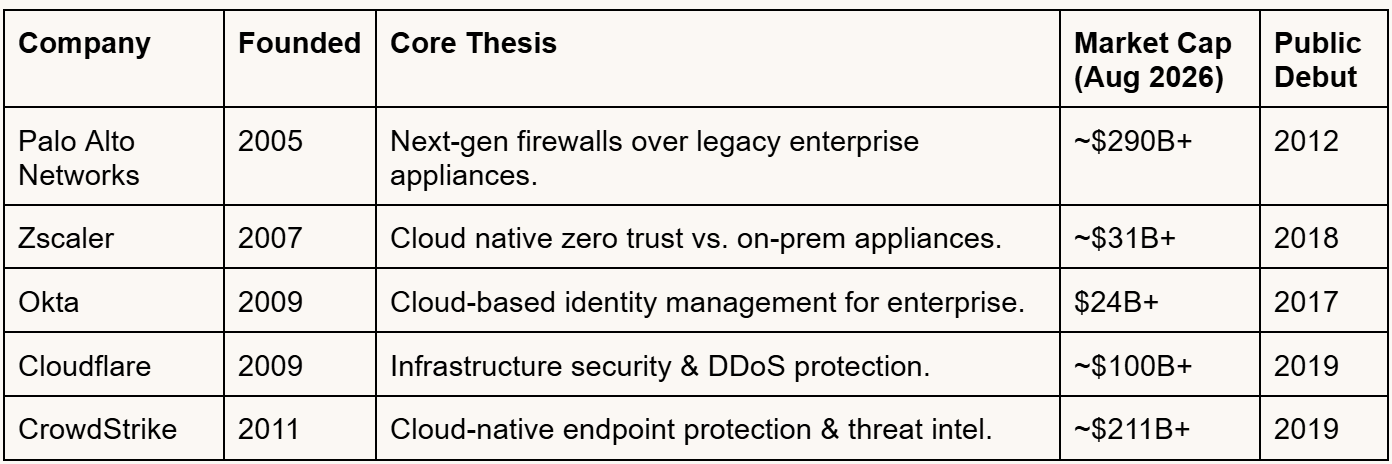
Cybersecurity was once dismissed by investment professionals as a low-margin, non-strategic cost center. In the late 2000s, investors shied away, viewing sales cycles as too long and customer acquisition as overly complex. Those who looked past the consensus were rewarded handsomely. The winners were not the linear, conventional thinkers; they were mission-driven experts with deep domain knowledge. Between 2012 and 2019, these companies went public and began a period of aggressive M&A, providing a clear, viable off-ramp for innovative startups. Each of these firms succeeded because its founders prioritized performance, focused intently on user needs, and had the foresight to build when the sector was out of vogue.
We are living through a similar structural migration in defense technology today. While more capital is flowing into defense tech now than into cyber during the 2005–2011 period, the potential market is significantly larger—a defense budget well over a trillion dollars. With more money comes more noise; therefore, backing the right companies is more critical than ever. Driven by geopolitical friction, autonomous warfare, and government reform, defense tech is shifting from legacy prime contractor dominance to a platform-led era fueled by AI and autonomy. The companies scaling today will become the next generation of prime contractors. In five years, the industry’s trajectory will likely mirror the maturation of the cybersecurity sector in the late 2010s, following its own formative wave of innovation.
Only a few years ago in the early 2020s, defense technology was considered a backwater by consensus venture firms. It was labeled "uninvestable." The industry suffered from perverse incentives, slow iteration, and agonizingly long planning cycles. But sharp founders saw that it could change—and that they could force that change. Anduril’s Palmer Luckey championed this shift in the late 2010s; companies like Castelion and Saronic were founded in 2022. Now, more and more founders and builders, and investors, have caught on. The window to found new platform companies is still open, but the time is now. Recent conflicts have proven that modern warfare requires low-cost, software-driven, autonomous platforms rather than the monstrously expensive single-point solutions of the past.
Founders, early employees, investors, and forward-thinking government leaders are now architecting this future together. In the early 2020s, a cohort of nimble specialist venture managers and a select few larger firms began deeply engaging with the builders of this defense renaissance—a movement that started in Southern California and is rapidly spreading to Texas and beyond. Today’s leading cyber companies evolved from specific, high-impact insights into comprehensive platforms. We see the same trajectory for today’s defense winners, such as Castelion and Saronic. Founded just four years ago to solve distinct, critical problems—whether through rapid hypersonic development or autonomous maritime capabilities—they were initially misunderstood. Today, they are vital to U.S. national security.
By delivering novel solutions at orders of magnitude better price points than the legacy model, Castelion, Saronic and new defense technology companies have the room to scale into the next generation of prime contractors.